
Xander Franke · 6 November 2026
Recent adjustments to accreditation standards have pushed higher education institutions across Poland to embed mandatory climate modules within core degree pathways, and full compliance deadlines fall in November 2026. These changes affect programs ranging from engineering and economics to humanities and social sciences, according to records from the Polish Ministry of Education and Science. Data from institutional reports shows that more than 60 percent of sampled universities have already revised syllabi to include at least one required climate-focused course per undergraduate track. The policy shift stems from updated national qualification frameworks that now list climate literacy among essential graduate competencies. Researchers tracking curriculum databases note that modules typically cover greenhouse gas accounting, adaptation strategies, and policy instruments such as carbon pricing. Institutions must demonstrate measurable learning outcomes before degrees receive final approval.Timeline and Regulatory Drivers
Implementation schedules released in early 2025 set November 2026 as the date when all new enrollments must meet the revised criteria. Existing students receive transition provisions that allow completion under prior rules, yet many departments have accelerated rollout anyway. European Commission education reports highlight similar moves in neighboring member states, where comparable climate requirements entered force between 2024 and 2025.
Funding allocations from the National Centre for Research and Development now prioritize proposals that demonstrate integration of climate content, which has prompted rapid faculty training programs at several technical universities. Figures released by the centre reveal a 35 percent increase in climate-related project grants during the past academic year.
Institutional Responses Across Disciplines
Engineering faculties have introduced modules that link thermodynamics to renewable energy systems, while business schools added coursework on climate risk disclosure and sustainable finance. Humanities programs incorporate case studies of regional adaptation, drawing from Baltic Sea data sets maintained by the Institute of Oceanology. Observers note that interdisciplinary teams now co-teach many of these courses, combining expertise from atmospheric physics and environmental law.
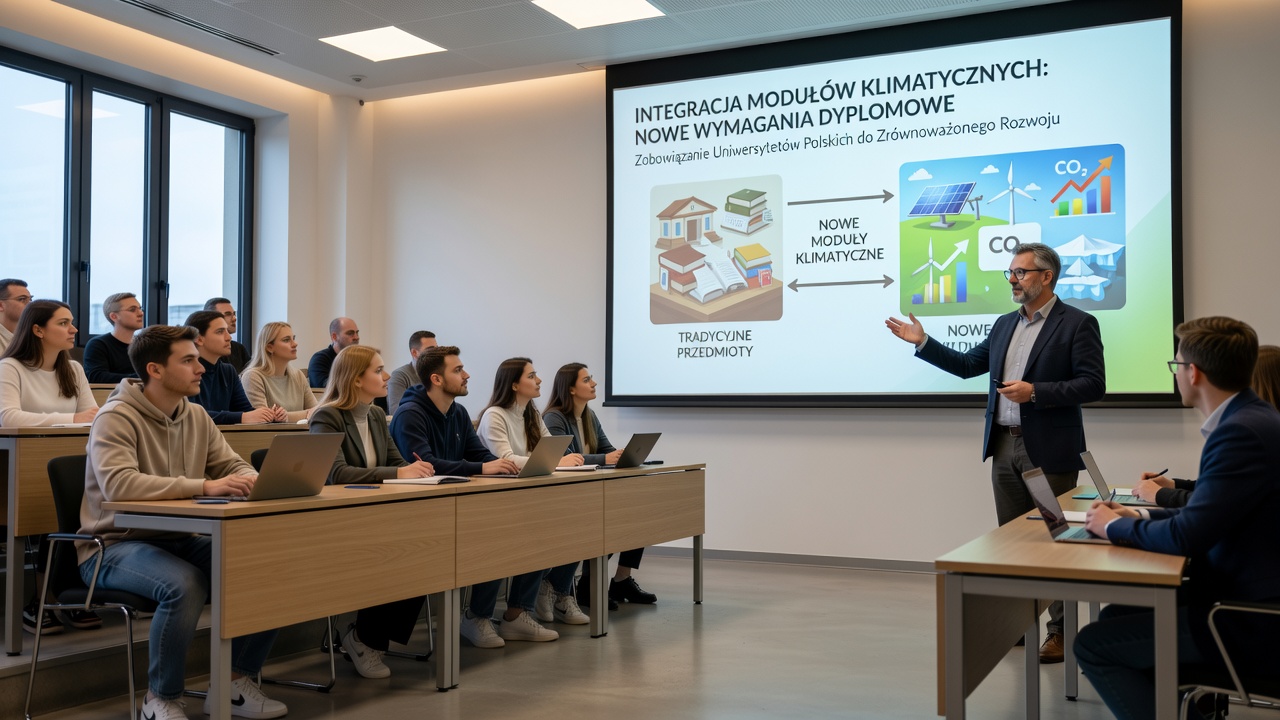 One study released by the Conference of Rectors of Academic Schools in Poland tracked pilot implementations at five institutions and found enrollment in climate modules exceeded initial projections by 18 percent. Departments report higher demand for electives that build on the mandatory base, suggesting students seek deeper specialization once introduced to the topic.
Resource Allocation and Faculty Preparation
University budgets have shifted to support new teaching positions and digital resources, including simulation tools for carbon footprint modeling. The Ministry of Climate and Environment partnered with academic consortia to supply open-access datasets that satisfy accreditation audits. Training workshops held throughout 2025 reached more than 2,400 instructors, according to attendance logs compiled by the Polish Rectors Foundation.
External partnerships supply additional capacity. A collaboration with the Australian National University climate education network provides comparative curriculum templates, while data exchanges with the US National Oceanic and Atmospheric Administration supply updated regional projections for Central European case studies. These arrangements appear in official memoranda of understanding published on institutional websites.
Student Outcomes and Assessment Changes
Assessment rubrics now require students to apply climate concepts within their primary discipline, such as calculating emissions reductions for a civil engineering capstone or modeling policy impacts in an economics thesis. Early indicators from internal reviews show average scores on climate literacy pre-tests rising after module completion, though longitudinal tracking remains underway.
Conclusion
By November 2026 the majority of Polish degree programs will operate under the new climate integration standards. Ongoing monitoring by accreditation bodies will determine whether further refinements occur in subsequent cycles, and comparative data from other European systems continues to inform adjustments. The structural changes reflect broader alignment between national education policy and international climate commitments tracked by the United Nations Framework Convention on Climate Change.