Xander Franke · 9 October 2026
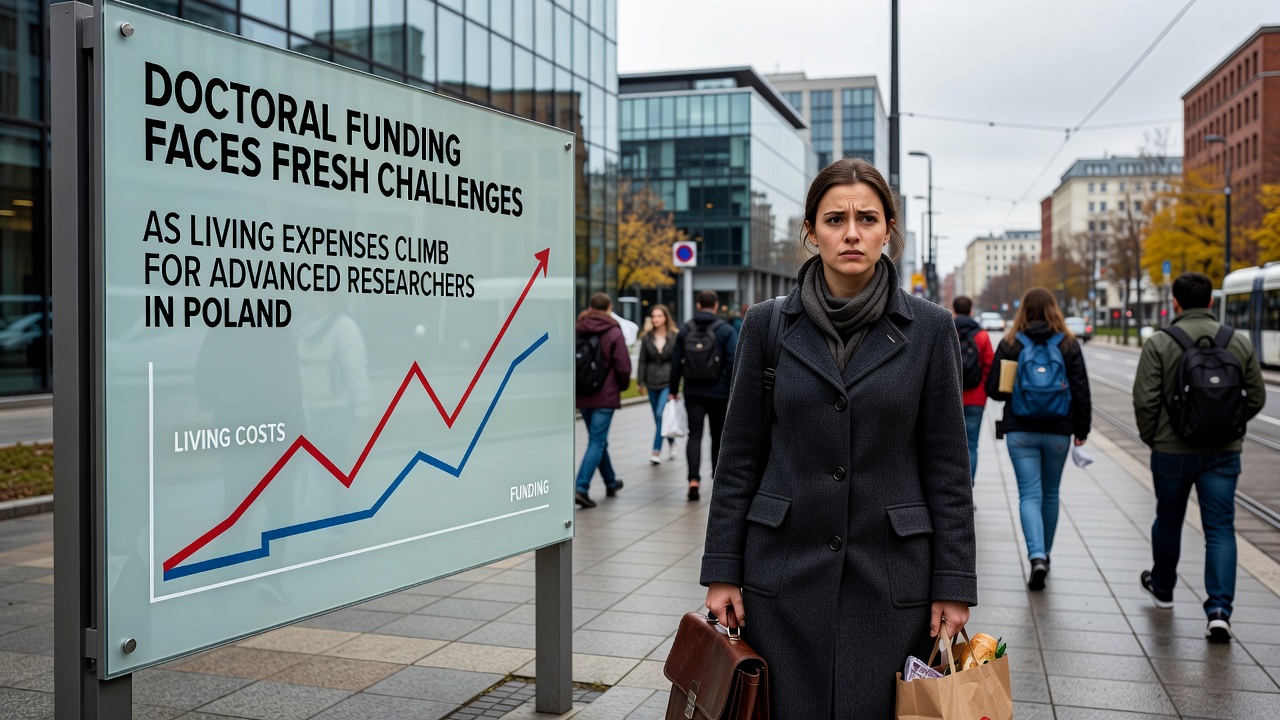
Doctoral Funding Faces Fresh Challenges as Living Expenses Climb for Advanced Researchers in Poland
Advanced researchers in Poland encounter mounting pressure as doctoral stipends struggle to keep pace with rising living expenses across major cities and smaller academic centers alike. Data from recent national surveys show that monthly costs for housing, food, and transportation have increased steadily since 2023, while base funding levels for PhD candidates remain tied to fixed ministerial scales. Those who study in Warsaw, Krakow, and Wroclaw report the steepest gaps between income and outgoings, and many now combine research duties with part-time employment to cover basic needs.
Current Stipend Structures and Their Limits
Poland allocates doctoral funding primarily through the Ministry of Science and Higher Education, with stipends set at approximately 2,800 PLN for standard candidates and slightly higher rates for those holding additional grants. Researchers who secure external awards from the National Science Centre or European Union programs receive supplemental support, yet these sources cover only a fraction of the total doctoral population. Observers note that the fixed stipend amounts have not undergone adjustment proportional to inflation indices published by the Central Statistical Office in 2025 and early 2026.
Take one researcher who entered a program in 2024 and found that rent alone consumed more than half the monthly stipend within the first year. Colleagues in similar situations describe shared apartments, reliance on family support, and reduced time available for core research tasks. Figures released by university administrations indicate that over 60 percent of doctoral candidates in technical fields now report supplementary income sources, a marked rise from levels recorded five years earlier.
Living Costs in Key Academic Hubs
Housing markets in university cities tightened further during 2025, with average studio apartment rents climbing above 2,200 PLN in central districts. Food and utility expenses followed similar upward trends, driven by energy price fluctuations and supply chain adjustments documented in European Commission reports. Researchers based outside the largest centers sometimes face lower rents, yet they encounter higher transportation costs when accessing specialized laboratories or libraries located in major hubs.

October 2026 brought renewed attention to these patterns after the release of updated cost-of-living indices from the Polish Statistical Office. The data showed a 14 percent year-over-year increase in combined living expenses for students and early-career researchers, outstripping stipend growth recorded over the same period. International comparisons compiled by the OECD placed Polish doctoral support near the lower end of European benchmarks when adjusted for purchasing power, prompting discussions among academic unions and institutional leaders.
Institutional Responses and Emerging Adjustments
Individual universities have introduced targeted supplements for candidates in high-cost locations, drawing on internal budgets and limited private donations. These measures vary widely by institution, with some offering one-time housing grants and others expanding access to subsidized canteen meals. A study conducted at Jagiellonian University tracked stipend recipients over 18 months and found that supplemental aid reduced reported financial stress by measurable margins, although the programs reached only a subset of eligible candidates.
Government agencies continue to review funding formulas, and proposals circulated in late 2025 included indexing stipends to regional cost indicators. Implementation timelines remain under discussion, with pilot programs scheduled for select institutions beginning in the 2027 academic year. Meanwhile, researchers increasingly turn to short-term contracts and teaching assignments, a shift that can extend overall program duration and affect research output timelines.
Broader Implications for Research Continuity
Extended financial strain correlates with higher attrition rates in several doctoral programs, according to internal university statistics shared at national conferences. Fields requiring extensive laboratory access or fieldwork report particular difficulties, because candidates must balance paid work against time-intensive experiments. European Union mobility schemes provide temporary relief for some researchers who relocate temporarily, yet returnees often confront the same domestic cost pressures.
Academic networks across Poland have begun compiling case studies that illustrate these dynamics, and the resulting reports feed into ongoing policy consultations. Data compiled through 2026 show consistent patterns: candidates without independent financial resources face longer completion times and reduced participation in international conferences. Institutions that track these metrics emphasize the need for sustainable funding models that account for geographic and disciplinary differences.
Conclusion
Poland's doctoral funding environment continues to evolve amid persistent gaps between stipends and living costs. Government reviews, institutional supplements, and researcher adaptations shape the current landscape, while data from 2026 underscore the scale of adjustments still required. Continued monitoring by statistical agencies and academic bodies will determine how effectively new measures address these challenges in coming years.